How to get your brand cited by ChatGPT: a step-by-step guide
Ranking on Google isn't enough anymore. Here's how to get your brand named in ChatGPT, Perplexity and AI Overviews when your customers ask questions.
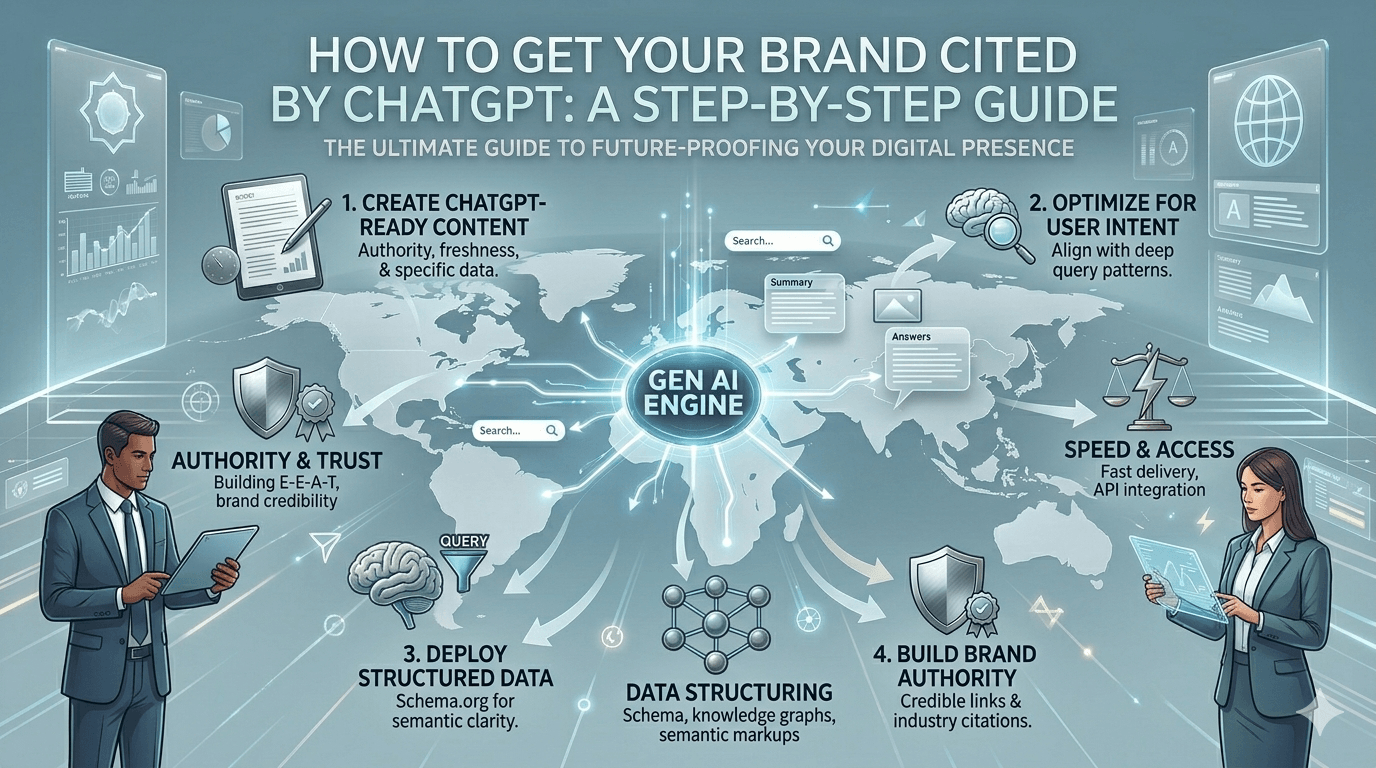
A few years ago, the goal was simple: rank on page one of Google. If your content sat at the top, the traffic followed. That’s still worth doing – but it’s no longer the whole game.
More people are using ChatGPT, Perplexity, and Google’s AI Overviews to get answers directly. They ask a question, get a response, and never click through to a website. In those responses, some brands get named. Others don’t.
This guide is about making sure you’re one of the ones that get named.
Why ChatGPT citations matter
When ChatGPT recommends a tool, references a company, or describes a solution, users treat it as a trusted endorsement. They didn’t search for your brand – the AI surfaced it for them. That’s a useful position to be in.
The catch? ChatGPT doesn’t work like a search engine. You can’t pay to appear. You can’t game it with keyword density. It draws on what it knows about the web, and it tends to reference sources with genuine authority on a topic.
So the question isn’t how to trick it. It’s how to build the kind of presence that makes you the obvious answer.
How does ChatGPT actually choose what to cite?
ChatGPT’s models are trained on large amounts of web content. When a user asks a question, the model generates an answer based on what it’s learned. In tools like ChatGPT with browsing enabled, or in Perplexity, it also pulls live web sources.
A few things consistently influence whether a brand or piece of content gets referenced.
Does your content make it clear what you do and who you help? Vague positioning gets passed over. Specific, plainly stated expertise gets remembered. When other credible sites link to you, quote you, or reference you by name, that signals authority – similar to an academic citation, where the source matters as much as the claim. Content that directly answers questions also tends to do well; if someone asks “how do I do X” and you’ve written a clear explanation of exactly that, you’re already in the running. And if your brand appears in the same context across multiple sources – your site, guest articles, industry directories, press coverage – the model builds a more confident picture of who you are.
Step 1: Be specific about what you’re known for
Before you can get cited, you need to be known for something specific. “We do digital marketing” doesn’t give AI models much to work with. Narrow, confident positioning does.
Ask yourself: if someone asked ChatGPT about your niche, what specific question should your brand be the answer to?
For a mortgage broker, that might be “best specialist mortgage lenders for self-employed buyers.” For a local accountant, it might be “accounting software for freelancers in the UK.” Get that specific.
Once you’ve defined it, make sure it’s front and centre on your homepage, your About page, and the opening of your key content. Don’t make the AI infer what you do – tell it plainly.
Step 2: Write content that answers the actual prompt
Think about how your target customer would phrase a question to ChatGPT. Not a search query (“best mortgage lender”) – a conversational prompt (“what’s the best mortgage lender for someone who’s self-employed with variable income?”).
Those two look similar but they’re structurally different. AI prompts tend to be longer, more specific, and more contextual. Your content needs to match that.
Lead with a direct answer, not a three-paragraph run-up. Use question-led subheadings where they fit naturally. Cover the nuance – a surface-level explainer won’t compete with content that addresses the follow-up questions people actually ask. And keep your language plain. If the AI has to decode your prose, it’ll pick someone else’s.
A useful frame: write every piece as if you’re answering a question from a client who trusts you and wants the full picture.
Step 3: Build your third-party footprint
Your website alone isn’t enough. For AI models to treat you as an authoritative source, other credible sources need to back you up.
Write for industry publications and trade sites. When a respected outlet publishes your name alongside your area of expertise, that connection gets reinforced. Offer yourself as a source to journalists and content creators in your space – even a brief quote in a roundup creates an external mention that links your name to a topic.
Original research is worth particular attention. Data studies and surveys give other sites something concrete to reference, and that builds your citation footprint faster than almost anything else. Make sure you’re also listed accurately in the relevant industry directories and accreditation bodies – these often rank well and feed into AI training data.
Step 4: Structure your content for AI readability
Some content formats are easier for AI models to extract and use.
A well-structured FAQ that directly answers your customers’ questions is almost purpose-built for AI citations – keep answers concise and jargon-free. Step-by-step guides with clear headings also perform well, as long as each step is genuinely useful and not padded. If there’s a term in your industry that people regularly ask about, write the clearest explanation of it you can. Own the definition.
Comparison content (“X vs Y”) answers a question that lots of people ask conversationally, and done well it’s likely to get pulled into AI responses.
Use schema markup where you can. FAQ schema, How-To schema, and Article schema all help crawlers understand what your content is and how it’s structured.
Step 5: Test whether it’s working
You can’t track ChatGPT citations the same way you track Google rankings, but you can test it manually.
Open ChatGPT, Perplexity, or Claude and ask the questions your customers are most likely to ask. Does your brand come up? If not, who does and why?
Make this a monthly habit. As you publish more and build more third-party mentions, you should start to see your brand surface more often. Some tools are starting to offer AI visibility tracking as a proper feature, but even a simple manual audit once a month tells you a lot.
What not to do
A few things people try that don’t work.
Stuffing your content with references to “ChatGPT” or “AI search” won’t help. The AI doesn’t reward you for talking about it. It rewards expertise on the topics your customers actually care about.
Publishing lots of shallow content is worse than publishing less, better content. Ten thin articles won’t outperform one genuinely useful guide.
And don’t treat this as separate from SEO. The things that get you cited by AI models – clear expertise, quality backlinks, well-structured content, third-party credibility – are largely the same things that improve your Google rankings. A good GEO strategy and a good SEO strategy point in the same direction.
One honest note on timelines
Getting cited by ChatGPT isn’t something you can force in a week. AI models have training cutoffs and update schedules, which means new content doesn’t immediately feed through.
What you’re really building is a reputation across your own site and across the wider web, in how your brand is discussed and referenced by others. That takes time. But businesses that start now will have a real head start over those that wait.
Think of it like compound interest. A guest post here, a well-written guide there, a bit of digital PR, it adds up faster than you’d expect. And once the AI starts citing you, it tends to keep doing it.
Before you close this tab
Five things worth doing today:
- Write down the single question ChatGPT should answer with your brand name
- Read your homepage and About page — is your expertise stated plainly?
- Identify three industry publications you could pitch a guest article to
- Check your FAQ page, or note that you need to create one
- Run your core topic through ChatGPT and see who it currently cites
None of this is complicated. It’s mostly just good content practice, applied with AI visibility in mind.
Related reading
Want this kind of thinking
applied to your business?
No hard sell. No jargon. Just an honest conversation about what's working, what isn't, and what we can do about it.
Get in touch